System Design Deep Dive: The CAP Theorem

Subject: System Design Deep Dive: The CAP Theorem
Welcome back to another technical deep dive by @BitSeByte. Today, we are exploring the cornerstone of distributed system decisions: The CAP Theorem.
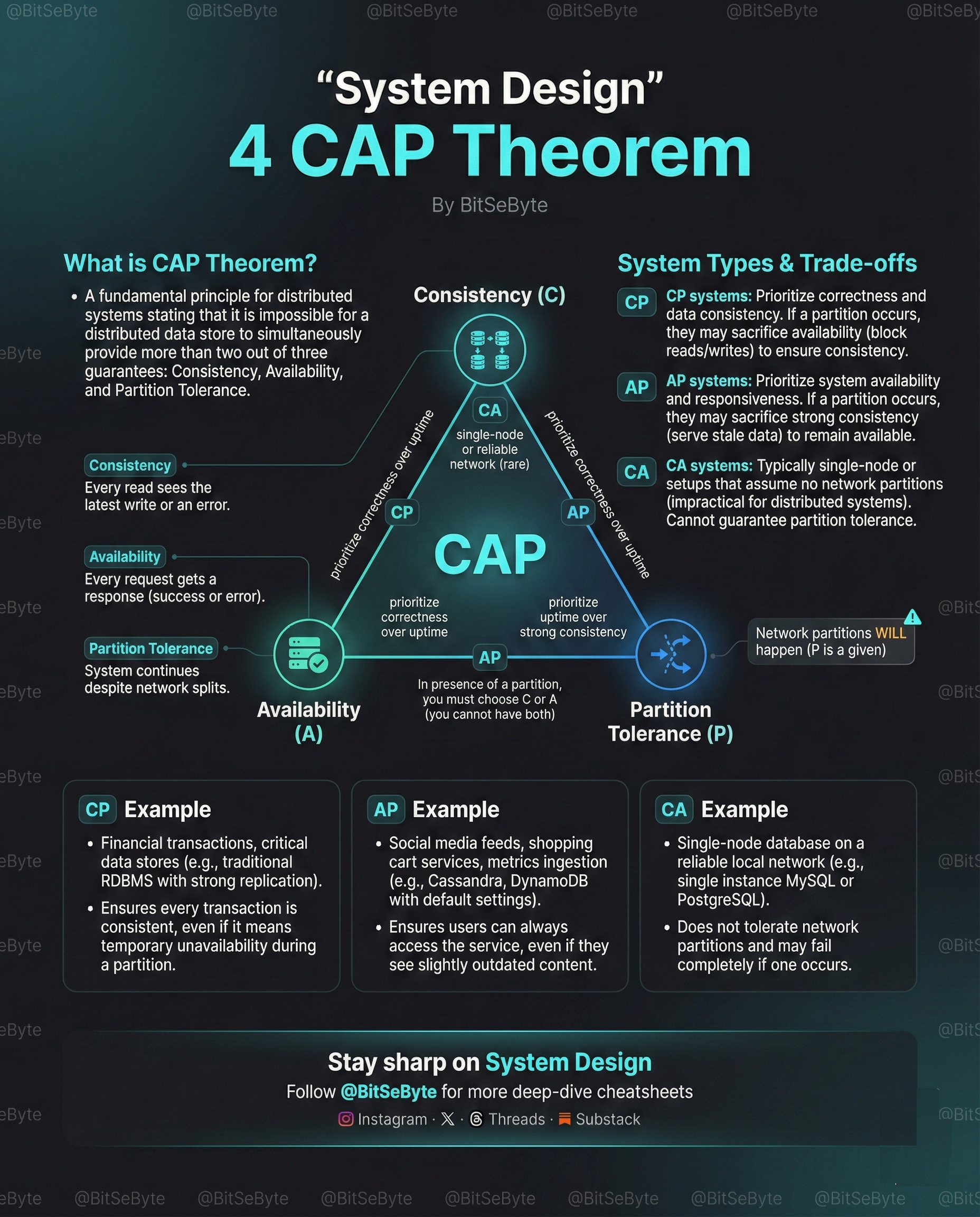
WHAT IS THE CAP THEOREM?
It is a fundamental principle stating that it is impossible for a distributed data store to simultaneously provide more than two out of three guarantees:
1. Consistency (C): Every read receives the most recent write or an error. All nodes see the same data at the same time.
2. Availability (A): Every request receives a (non-error) response, without the guarantee that it contains the most recent write.
3. Partition Tolerance (P): The system continues to operate despite an arbitrary number of messages being dropped or delayed by the network between nodes.
THE TRADE-OFFS: CP VS. AP
While often explained as "Pick Two," in reality, Partition Tolerance is mandatory for any distributed system because network failures are inevitable. This leaves you with two main architecture types:
• CP Systems (Consistency + Partition Tolerance)
These systems prioritize correctness over uptime. If a network partition occurs, the system will block reads or writes to ensure data remains consistent.
Example: Financial transactions or traditional RDBMS with strong replication.
• AP Systems (Availability + Partition Tolerance)
These systems prioritize uptime over strong consistency. If a partition occurs, the system continues to accept writes and serve reads, even if the data is slightly outdated (eventual consistency).
Example: Social media feeds, shopping carts, or DynamoDB.
• CA Systems (Consistency + Availability)
These are theoretically possible but generally impractical for distributed systems because they cannot tolerate network partitions. These are typically single-node setups.
Keep this guide handy for your next architectural revie
w!
Best,
The @BitSeByte Team